Fique is an imposing plant, native to Colombia and classified scientifically within the genus Furcraea sp., of which some twenty species exist.
Its form is characterised by an upright stem from which spring long, fleshy leaves of an intense green, crowned at maturity by greenish-white flowers. The plant organises its growth as a rosette: new leaves are born at the centre and push the older ones outward, which descend and open until they lie almost horizontal.
That architecture is what makes sustained use possible. Harvesting respects the plant’s biological cycle: growers cut the leaves nearest the base — the most mature, with the longest and strongest fibre — leaving a minimum of fifteen to twenty pencas in the cogollo to guarantee the survival and regeneration of the plant.
You are harvesting a fique plant. How many pencas do you leave in the cogollo?
The maguey: the end of the cycle
At the end of its useful life the plant sends up from its centre a long flower stalk that can rise several times the height of the rosette. In local speech, that structure and the plant that produces it are both known as maguey. Its appearance announces the close of the cycle: the plant concentrates its reserves in flowering and, after it, dies.
After flowering, the fique plant produces leaves again.
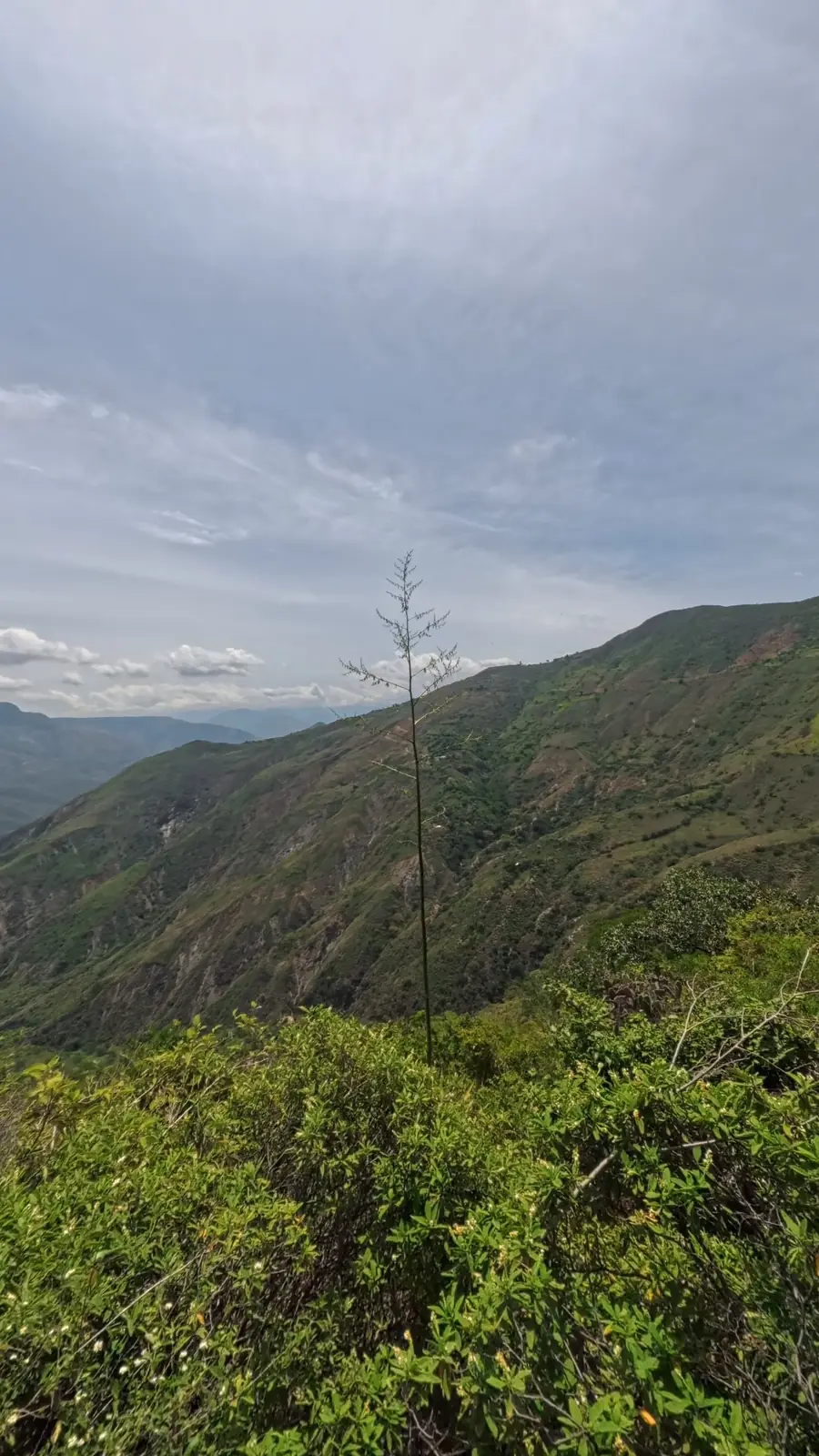
This outcome forces the crop to be thought of in terms of succession. A fique plantation is sustained not by the longevity of its individuals but by staggered renewal: while some plants produce, others grow and others flower. A grower who only harvests, without planting replacements, condemns the plot to a gradual emptying.
Growing conditions
Fique adapts to soils of low fertility and to steep ground where mechanisation is impossible. It needs little water, demands no permanent irrigation and tolerates long dry spells. These characteristics historically made it the crop of the land no other product wanted.
Does fique need permanent irrigation?
There is also an environmental benefit frequently overlooked: through its root system and its arrangement on the slopes, fique plantations contribute to holding the soil and containing erosion on steep ground, of the kind that characterises much of Aratoca’s territory.
From leaf to fibre
Within the penca, the fibre is organised in longitudinal bundles embedded in fleshy, watery tissue. The whole process of transformation described in the next chapter consists, essentially, of one operation repeated with different tools: separating the bundle from the pulp without breaking it. The length, sheen, colour and strength of the final thread all depend on how cleanly that separation is achieved. It is there, in large part, that the commercial value of the finished piece is decided.